

Seeking the Light
- skagitjack
- Nov 1, 2025
- 6 min read
Do you seek the light?
Here we are, entering the Big Dark. The months with the shortest, cloudiest, coldest, and rainiest days.
But there is a tree that reminds us of the coming return of the sun.
This tree brightens dark days with its glowing bark of bright orange and shimmering evergreen leaves. Right now, its Christmas-red berries stand out against autumn hillsides, feeding wildlife at a time they need it most. And come spring, it will awaken our hillsides with bouquets of brilliant white flowers.
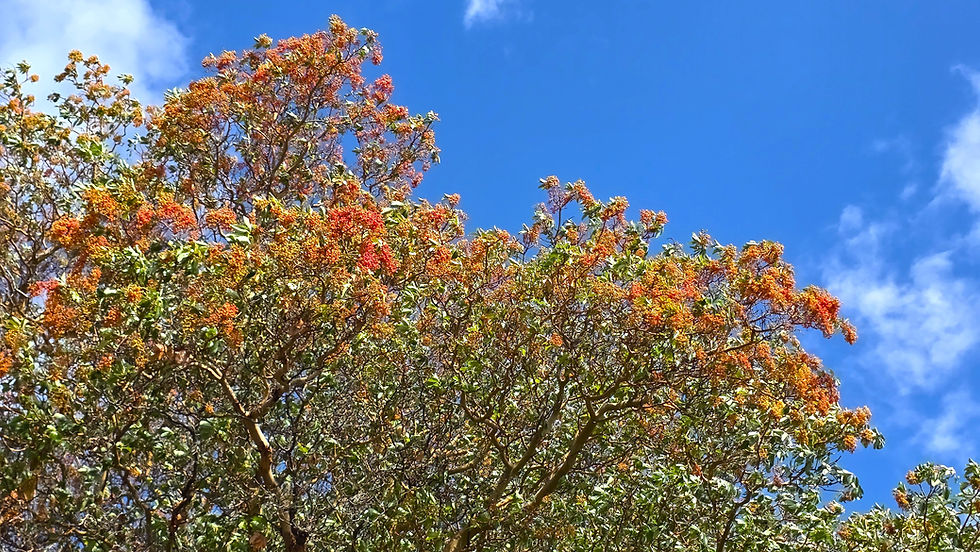

This is the Pacific Madrone.
They range from southern British Columbia down to the hills of Santa Barbara. Here we are near the northern edge of survival, although climate change may extend it further north in the coming decades.
The preferred habitat of madrones reminds me of my favorite places to live. Think about these locations: shorelines near the Salish Sea, facing the water, where the sun shines, with open woods and grasslands. Who wouldn’t want to live there?!
They are not very frost-resistant. They reach for the sun, yet overexposure can cause sunscald to their thin bark. Again, kind of like us.


And what’s with that thin-skin bark? Shaded portions and the oldest trunk will retain a scaly gray or black bark. But the bark peels from that portion of the tree exposed to strong light. The bark peels off naturally to expose new bark underneath. Like snakes shedding their skin, madrones shed their bark quite aggressively. Some think the exfoliating bark is an evolutionary response to fungus or boring beetles, some think it is a natural adaptation of their swelling girth.
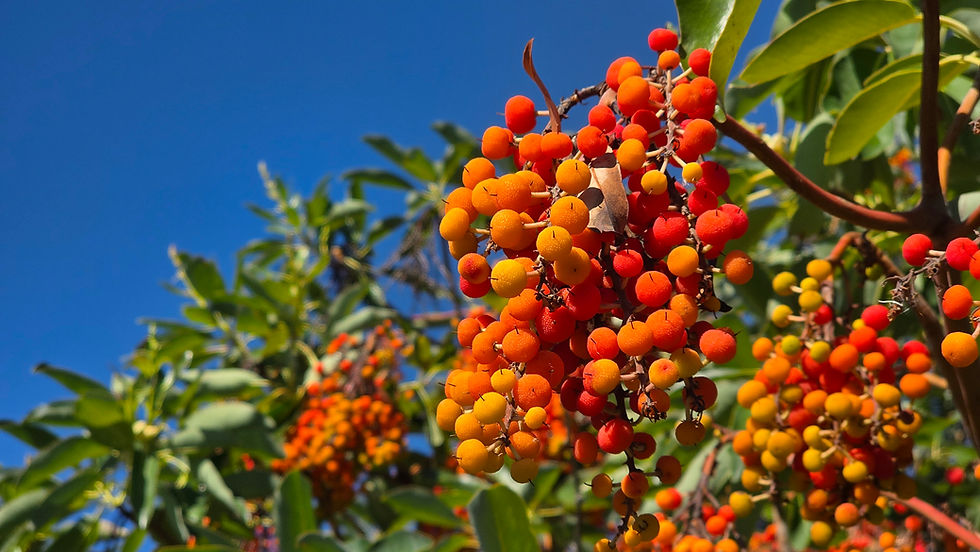
Madrone trees are often small, with several trunks arising from a central point, an indication of their ability to stump-sprout after a disturbance, such as fire or a chainsaw. Its fruits serve as food for a variety of birds, raccoons, and the occasional black bear. As the berries are produced in great quantity and may persist on the tree into winter, wildlife are grateful for their gifts.
Not Made in the Shade
But to be healthy and share their gifts, madrones need light. Everywhere it grows, it thirsts for light. It quests for any break in the forest canopy. Sculptural, showy, twisting, bending, the madrone is the agile gymnast of the forest, corkscrewing skyward. Any branches eclipsed by the forest canopy quickly die, even while the rest of the tree grows.

Walk around Cap Sante, or Little Cranberry, or along any south-facing rocky shore, such as at Washington Park, Bowman Bay, or anywhere else with southern exposures along the Salish Sea. You will find madrones stretching out from their roots in the forest, hanging over cliffs, reaching over the water, seeking in any manner they can to gather light.

Each one is distinct: the two at the Rotary Park pavilion (one now fallen into the harbor); the hundred-sprout one near the castle at Fort Worden, Port Townsend; the big one on the north shore of Bowman Bay, on the southeast side of Rosario Head, or at Lottie Point; the one on the western rocky face of Little Cranberry. Or on Kiket Island, or the south shore of Penn Cove, or...
Where are your favorite madrones? Do you have a photo or story to share?
Madrone depends on periodic fires to reduce the forest canopy so it doesn’t shade them out. But fire suppression policies prevent this from happening. As a result, the Pacific Madrone is being overshadowed by species that can better tolerate the expanding shade.
The thin bark is susceptible to fire, yes, but new saplings readily sprout with newly reduced competition for the sunlight. The east side of Little Cranberry is full of them now, nine years after the fire. Look at all the seedlings now becoming trees! Mature trees survive fire and can regenerate more rapidly after fire than Douglas-firs. Pacific madrones also produce large numbers of seeds, which sprout following fire.

Seeking the Light
But as I sat under a madrone yesterday along the shores of Lime Kiln State Park, the tree gave me a different kind of gift, asking me a personal question: Do I seek the light? And if so, what do I do with it?
Here was this tree, reaching out with all its energy to gather more light, living where it sprouted, sharing its resulting fruit with all who desire it. Shining brightly in all weather, rain or shine, summer or winter. Hardy and sturdy, but not wasting any more energy where the forest has become dark and shaded.

I want to be like that. Darkness seems to be increasing around us, in our weather and season, yes, but also in our culture, our concerns, our national discourse, international relations, and planetary changes. In the slow unraveling of what we thought was certain.
Still, I can seek the light, reflect the light, and share freely what I have gained from the light. Together we can be the light the world needs, each in our place, growing where we are planted, bright and strong in all that we face.
It’s there. I need to seek it more, and not dwell on the growing darkness. Darkness is not the opposite of light; it is simply the absence of light.
“In the midst of winter, I found there was, within me, an invincible summer. And that makes me happy. For it says that no matter how hard the world pushes against me, within me, there’s something stronger – something better, pushing right back.” ― Albert Camus
jack
I'd love your feedback! Email me at skagitjack@outlook.com
What’s in a name?
The madrone’s scientific name, Arbutus menziesii, has fascinating connections.
Arbutus comes from “arbor”, which is Latin for tree, which comes from “arthos” in an earlier language which came from “herdhos” meaning upright or height, from a root word of “eredh”, to grow higher (which is where we get “ortho” — can you relate words that start with that for a fun connection?) And arbor for trees led to their use for building houses, which led to being a word about lodgings, or a shelter, which gave us the word “harbor” for a safe dwelling place. All that from the word for tree!
menziesii:
On May 2, 1792, Archibald Menzies, a surgeon and naturalist on the George Vancouver Expedition, landed on the shores of Discovery Bay. He found not only Douglas firs and alder but also what he called the “Oriental Strawberry Tree,” which he described as “a peculiar ornament to the Forest.” He noted “its large clusters of whitish flowers & ever green leaves” and its “smooth bark of a reddish brown colour.” Menzies assumed the native tree was an oriental strawberry tree since it resembled a Mediterranean species, Arbutus andrachne. In 1814, the American botanist Fredrick Pursh recognized the tree as a distinct species and named it Arbutus menziesii in honor of its discoverer.
Madrone or Madrona:
This name is from the Spanish name, Madroño, the name for the closely related Strawberry Tree of the Mediterranean region. Father Juan Crespi (1721-1782), a Spanish missionary in California, discovered these trees that he thought were similar to the Madroño. My dad called them madrona, easier on the tongue, and a nod to its Spanish origins.
In British Columbia, it’s called Arbutus. Seattle calls them magnolias, as in Magnolia Bluff in Seattle. Wait, what? Captain Davidson of the U. S. Coast Survey in 1856 mistook the madrones for magnolias. The error remains, but the trees still flourish there, not caring what we call them.
Champions:
On good ground, madrone can really grow, with large single trunks and considerable height and crown spread. The largest known specimen grows on the Big Sur Land Trust in California: 316 inches in circumference (over 25 feet!), 88 feet tall, with a spread of 116 feet. Oregon's champion is nearly as large.
The largest madrona tree in Washington WAS located at 8th and Cherry in Port Angeles. It stood 85 feet tall with a crown spread of 95 feet and a circumference of over 21 feet. It was considered the largest madrona in the state. However, it was cut down in December 2020 after being deemed a danger due to its advanced decline. The tree was estimated to be about 400 years old.
Madrones grow, give, and fade.
And still, while they can, they seek the light.


Comments