

Just One Mile
Updated: Feb 14

The Na Pali coast of Kaua’i Island is famous for its sheer razor-sharp ridges eroded over millions of years from the old volcano that created the island. Movies such as Jurassic Park, Avatar, Tropic Thunder (which my kids loved), King Kong, Pirates of the Caribbean, and many others have taken advantage of these cliffs as a tropical backdrop to their stories. An 11-mile hike along the Na Pali shoreline is famous as one of the more challenging and certainly more beautiful hikes to try as a life bucket-list goal. That trail offers daunting terrain even for seasoned hikers.
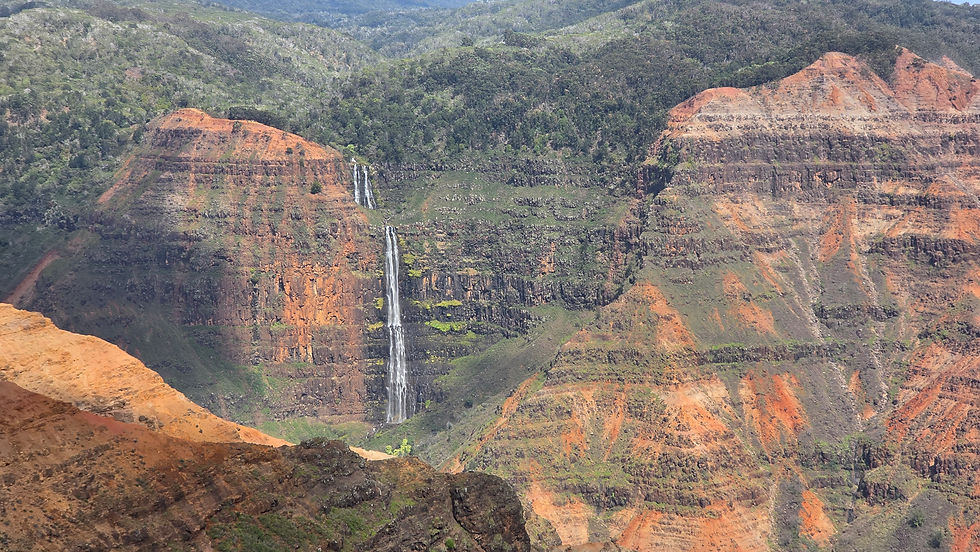
But we were at the top of all this. It was 82° when we left our beachside condo in Po’ipu. It was 65° when we got to the top. We had driven up along the Waimea Grand Canyon to the end of the road, a stunning viewpoint above the Na Pali ridges dropping far away to our west, the canyon to our east. Straight ahead of us was a simple one-mile trail, the Pihea Trail, leading to a minor peak with different views overlooking the Kalalau Valley. (Pronounce that as “call a low,” the ‘lau’ rhyming with cow.)

Soaring 4000 feet above the Pacific Ocean, these crumbling volcanic shoulders are eroded by 400 inches of rain every year, making it one of the wettest places on the planet. Year-round warm temperatures create lush tropical vegetation — and as we found out, treacherous hiking routes. The red clay becomes especially slippery during the winter months.
If we had more time, we could have gone an additional two miles through the Alaka’i Swamp to an overlook that looks out over the North Shore, but we had a sunset whale watching boat tour to catch, so we chose this shorter route, this easy hike, just a mile and a quarter out and then back again. The guidebook said it is a must-do.
Clothed in just shorts and T-shirts, with water, lunch, and extra clothes in our packs, we began. The trail starts down a wide clay-covered boulder field, which years of foot traffic and 400 inches of rain have eroded into footsteps and stream channels. Down and down we went, making sure of each step to keep from slipping. We asked a middle-aged couple coming back up to the trailhead if it gets easier pretty soon. The man snorted and said, “Goose grease.” His wife helpfully explained that the trail gets worse, and far slipperier.
It was an honest warning. The trail was a slick, sloppy, soupy surface. Goose grease made sense, kind of.
After getting down that boulder field, the trail mellowed out, becoming flat and relatively dry with good tread. Views of the Kalalau Valley dropped away at our feet to the left. Dense jungle filled the canyon to our right. No sounds of civilization reached this far. Tropical birds sang harmonies in the branches above. An upward breeze from Waimea Canyon began to blow wisps of clouds that dissipated once they fell over the ridge into Kalalau. The drama of a 4000-foot drop from our trail into that valley, rimmed with ridges down to the distant shoreline and the blue waters of the Pacific, is breathtaking. Vibrant white tropic birds floated above the valley. This was paradise, for sure.

At the half-mile mark, the work of hiking began in earnest. The trail now climbed, through and around and over rocks and fallen tree trunks. We made sure of each step before putting our weight on them, but slip happens. Handholds of vines and root branches helped. So did patience. So did my long legs. They made the high rock steps more doable. Kath's shorter legs struggled to get over some of the tough spots. Her walking stick, and an occasional helping hand, kept her going. The trail offered various choices in places: do we want muddy steps up, or rocky but higher steps, or clambering over a fallen trunk? Each option led to further dilemmas; regardless, all the options meant getting a little dirtier and a little sweatier.
I would tell you how long it took for us to hike a mile and a quarter, but it would just make you laugh. The scenery slowed us down, taking a photo every 100 feet or so. As did the plants and wildlife in this natural tropical landscape, so unfamiliar to us, yet so captivating to explore inch by inch. And inch by inch we did our route finding: “Which option offers the best chance for me to not fall down in the mud?” we would ask ourselves. We were slow.
After the one-mile mark, the trail becomes steeper to rise to the peak of this Ridge. Here we worked our way through each new challenge, encouraged by a young couple going back down who said we were just about there! And then, yes, we were. The view to the northwest offered yet another perspective of Kalalau Valley. To the southeast, we could see the tops of jungle trees, vines, and those wispy clouds coming our way. The wind hit hard up here; I took off my hat to keep it from flying out to the ocean. After putting on an extra layer of clothing, we sat down to a joyful lunch: a sandwich, pieces of fresh pineapple, coconut, and banana chips. We drank most of our water, rested a few minutes, greeted a handful of new arrivals, then lifted our packs and headed back down.

Some say, including me, that going down is often harder than going up. It’s easier on the lungs, but it’s harder to see the footholds, and heels give less traction than toes. And our legs were already a little tired from the slog going up.
I did an impromptu dance in one slippery downhill stretch when my left foot slid sideways, only to have my right foot then slide the opposite direction when I tried to catch my balance! I slid down on that foot, hopped and skipped, and somehow stayed upright through it all. Kath hiked more carefully with her walking stick. But she still ended up on her butt once; we both laughed and shook our heads as she tried to dust the red mud off her derriere.
At the bottom of the final ascent, the main trail forks, one route going to the Alaka’i wetlands. We did end up going that way a few hundred yards until we realized we were not on the right trail. We backtracked a couple of times to finally find where we had missed the intersection.
Back at the one-mile marker, we met a woman our age looking at the trail getting steeper. She asked if it was worth it to make the final ascent. What do you say to a question like that? “It’s a great place to eat lunch,” I suggested. She chose to turn around, just a quarter mile from the summit.
This caused me to ask myself, “Why do I hike?” And I ask you, why do you hike?
Is it just for the view? For some trails, it is. Many incredible views can only be reached by getting off the roadway and into remote country like this. Photo ops that require extra effort to get there are certainly one motivation.
But we could see the fabulous view of Kalalau from the parking lot! Why hike to follow a ridgeline to a viewpoint that is just a slightly different perspective?
Our bodies crave being challenged, being active, and having a purpose, a destination.
“Why climb mountains?”
“Because they are there,” is the famous answer. It’s the challenge of achieving a distant, difficult goal, to say to ourselves we did that, knowing that in the near future we will not be able to. Such is the reality of life.
We fall down and get up again and keep moving to be somewhere that not everyone can get to, and then we share the stories, the joys, the serendipitous experiences of the adventure, and hopefully spark a seed of interest in others for their next adventure.
We bond with others on hikes, creating memories together. We build endurance and strength. Our mental well-being improves, our moods mellow, our stress levels shrink.
But it’s so much more than that, too. Getting from point A to point B is not the point.
Our spirits crave the wonder, the awe, the inspiration that comes from places and experiences far from the madding crowd. We long for the silence and serenity of being in the wild. Our senses long to feel the power of the wind, to touch real earth and deep water, to smell living landscapes, to visit the homelands of creatures absent from our sheltered lives, to taste the roots of our very existence.
We walked as in a dream the last half mile back. Bird songs we have never heard called to us as much as to their own partners. The majestic views repeated, the Kalalau Valley now on our right. We looked back at the ridge we had hiked, and were grateful for every step we had taken. We were a bit tired, but truly satisfied to have experienced this land so far from our home back in Skagit County.
Wonders are everywhere.

Since you made it this far, check out the video of our walk at:
It's just four minutes long.
Background (and underground)
Na Pali means The Cliffs.
Pu’u O Kila, the trailhead overlook, means Kila’s hill, or Hill of Kila. Unfortunately, Kila’s identity is not known. Pihea means driftwood, an unusual name for a trail nearly a mile above the beaches far below us. Waimea means reddish water, an apt description for the river running through the canyon out to the ocean, eroding through the iron-laden soil of the island.
Millions of years ago, what is now Kaua’i Island was directly over a hot spot, an opening in the mantle of the Earth, acting like a blowtorch cutting a hole through the North Pacific plate. The plate is moving northwest a few inches a year, but the mantle’s hot spot remains in the same place beneath. It blows molten rock into the ocean, creating first a seamount, which eventually grows high enough to become an island. As the North Pacific plate moves, the new island eventually loses its volcanic source, and a new island is created to the southeast. That new island became Oahu, and then Molokai, and then Maui, and then the Big Island, among others. There is now a new island forming east of the Big Island named Lo’ihi. You can't see it yet because it's growing under the water. Stick around for a million years and maybe our children’s children will vacation there. By then, Kaua’i will be lost to the ocean’s waves.
And why is there an apostrophe in Hawai'ian words, like I just did there? The Hawai'ian language has a glottal stop sound, kind of like what you put in the middle of the phrase "Uh-oh". Just add that same sound when you see an apostrophe. So O'ahu should be pronounced "Oh-ah hu", not :O wah hu" that you here on the mainland. And the second to last syllable is the one that is usually said with emphasis, so it would best be said as "O-AH hu".
maikaʻi! (My KA-ee) or, Good!


Comments