

Matters of size and age -- the Big Trees of Fidalgo (volume 1)
Size matters, I’ve been told. But also, I hear that quality matters, such as standing tall and firm, well protected on the outside, full of vitality on the inside, able to last for a long time. Still growing, sending out seed, a healthy specimen that gives and gives. All of these matter.
But size is distinctive all by itself, a treat for the eyes, and talked about by all who come into its presence to share in its delights.
That’s what each of these trees shares with us here on Fidalgo. These are examples worthy of our admiration and protection.
You may know of others that are even bigger. I truly want to hear from you about them. I am creating a list of the biggest tree that we can find for each species in town. Many are native trees, which means the biggest ones might be in the ACFL or Deception Pass or another protected place. Many will be exotics, not native to Skagit County, and more likely to be found along a city street or park. Will you share with me what you find? Let’s see what kind of list we can put together.
Here are three trees right here in downtown Anacortes you may already have come to know. They are the biggest of these three species, as far as I have found, so far, on Fidalgo.
[Oh, I should mention: the measurements you see listed are in feet of circumference, always measured at chest height, about 4 ½ feet above the ground. Divide this number by pi (about 3.14) if you wish to get the diameter.]
Sequoia (Sequoiadendron giganteum)
20’ 3” circumference, 6’ 5” diameter

Not far from Causland Park on 7th Avenue, this tree is the biggest I have found downtown. It stands out high above the low-rise residential neighborhood, and then when you see the trunk, you go, “Oh, my…!” Truly, it is magnificent. Its branches spread almost down to the ground. An old bench waits for you to sit there in the shade of this gentle monster. It must have been here a long time, of course, and grew so large that the sidewalk had to be moved out to the street’s curb to get around the tree.

Their natural habitat used to span much of the west millions of years ago, but with changing climates they came to live mostly on the west slope of the Sierra in scattered groves. It is related to the redwood and the dawn redwood trees, but it is a distinct genus from these two. They are among the oldest living organisms on Earth, with the oldest having been around for over 3200 years. The record for size is over 300 feet tall. The General Grant tree is 28.9 feet in diameter.
Sequoia National Park and Calaveras State Park protect some of the largest groves in California. Here in Anacortes, we do our best to take care of this one. Sequoia trees are not on the approved Street Tree List for the city, sorry to say. But with our care and the benefit of a changing climate (one of the few benefits), this tree should continue to grow well.
Bigleaf Maple (Acer macrophyllum)
17’10” circumference, 5’ 7” diameter

Not far from the sequoia stands a venerable kind giant in a gentle pastoral setting – the churchyard of Christ Episcopal Church. The graceful repose of this maple sets a peaceful and reverential tone for the grounds.
With the largest leaves of any maple, it can be shade-tolerant if required but grows rapidly if released into a gap in the sunlight. Mature trees can be over 150 feet tall and live for over 200 years, but their growth habit of dividing branches opposite each other can create pockets in the trunk that catch water and lead to rot and eventual failure at this weak point.
This specimen looks like it has ten fingers pointing upwards in supplication to the heavens, and with its age, just like me, there are signs of future failure, though hopefully not imminent.

When I was a child, my neighbors to the east had a large maple with branches spreading horizontally not far from the ground. My friends and I put sleeping bags between two of its lower horizontal branches to spend the night in arboreal delight, cradled in its arms. And who among us has not thrown maple seeds into the air to watch them helicopter back down to earth? That never gets old.
The species name of this maple refers to its large leaves, often more than a foot in length and width. Find it throughout Fidalgo Island, usually growing together in thick stands. In the winter, these stands are full of sunshine coming through the bare branches, if the sun chooses to shine in winter.
Douglas-fir (Pseudotsuga menziesii)
24’ circumference!

If you’ve hiked to Whistle Lake, you know which tree this is. It is the giant on the east side of the road as you get close to the restroom not far from the lake. It begs you to touch it, to sense its power and strength, its majesty and grandeur.
The largest known Douglas fir in the United States is near Lake Quinault, at over 300 feet. The widest is the Queets fir, with a 16-foot diameter!
Doug firs are not true firs; the generic name means false hemlock. And that bark, oh that bark. It can be several inches thick, enabling the tree to withstand all but the most intense of forest fires. Not only that, but after a fire burns and kills other trees, the seedlings of a Douglas-fir love sprouting and growing in the now-open ground, free of competition to find sunshine. Given enough time, as the trees create a shaded landscape, hemlocks will eventually take their place, as hemlock seedlings love shade. But we’re talking hundreds of years. Fires used to burn through our forests about that often, starting the cycle all over again.
Yes, their wood is excellent for basic construction. The frame of your house stands strong because it is probably made of Douglas-fir.
But this tree stands strong on its own merits, a tribute to past generations to have let it continue to live here, and a challenge to future generations to see the value in elders such as this.
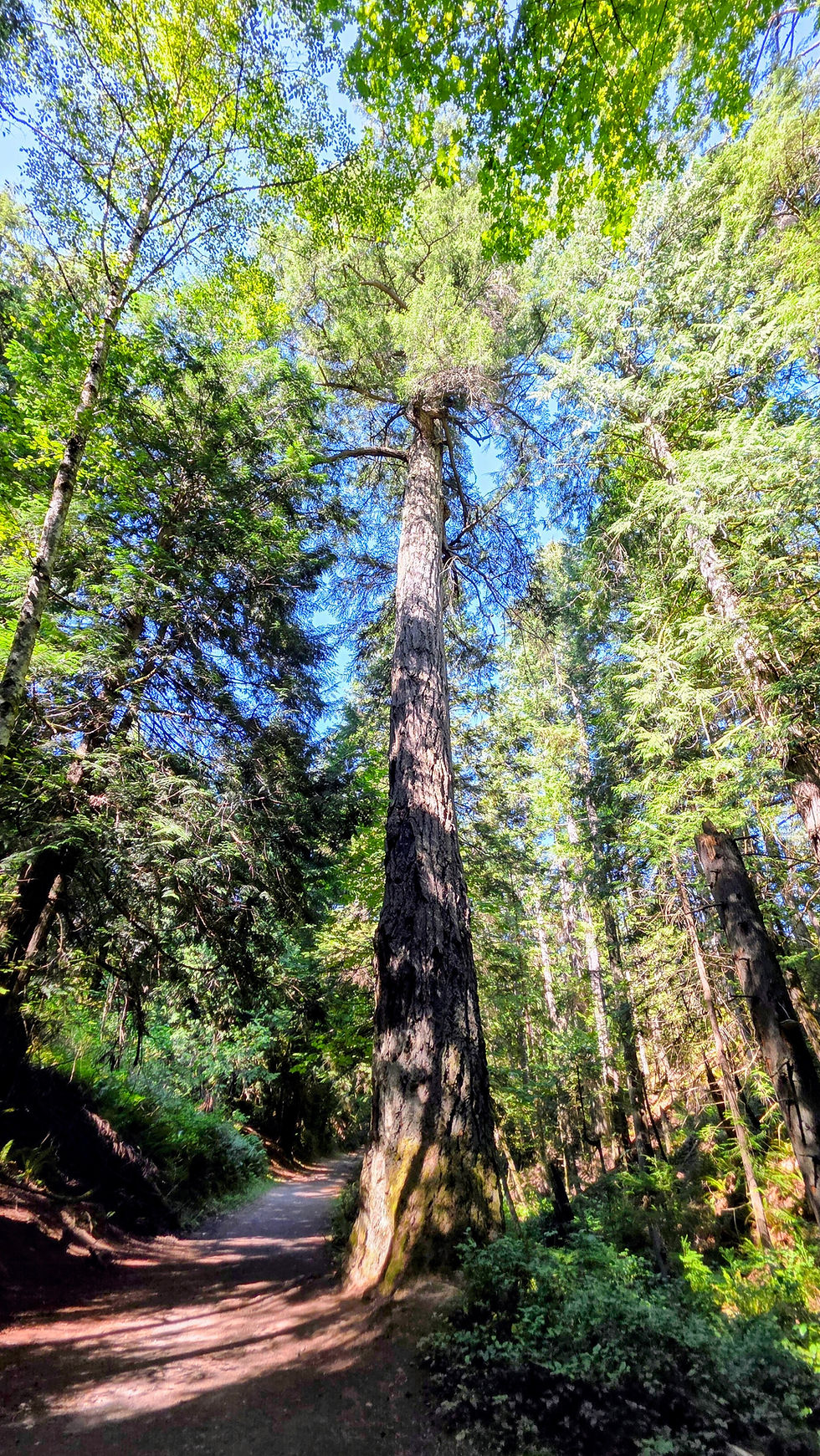
Yesterday afternoon, after a long day on the road for Kath and a whirlwind of indoor responsibilities for me, we hiked once again through the ancient woods near Whistle Lake. As we headed back home, we passed this giant, this ancient one. We left changed, by this tree, by all these trees, by us now carrying a bit of their silence and stillness within us. The old-growth giants remain behind, watching, whispering their slow wisdom into the wind.
They say that with age comes wisdom. And with size comes respect.
And perhaps most of all, this tree teaches that the later chapters of life are not a fading but a ripening — a slow, powerful expansion of who we have always been, and still are becoming.
Perhaps ancient trees live longer because they die longer — because they understand that endings are not abrupt but gradual, porous, and full of continued giving. They teach us that aging is not a vanishing but a soft, spacious unwinding into the forest of everything we’ve touched.

We don’t stop living when parts of us slow down.
We don’t lose value when we shed roles, ambitions, or capacities.
We continue to influence — quietly, steadily, sometimes more profoundly than before.
Aging becomes a long, slow transformation rather than a cliff. A gentle tapering rather than a sudden extinguishing. A widening of perspective rather than a narrowing of possibility.
Old trees teach that decline can be dignified, even beautiful. That longevity is not about resisting change but allowing it to unfold slowly, generously, gently, without fear, without hurry, without losing the capacity to give.
They die longer because they live all the way through their dying.
And that, strangely, beautifully, is what makes these giants so powerfully intimate and alive.


Comments