

It Takes a Village
We wanted to camp near Neah Bay last weekend and hike to Cape Flattery and Shi-Shi Beach. Who knew how it would open the eyes of our hearts to this world?
(Check out the video. It is 5:50 minutes long)

This is the land of the Makah Nation. Their Hobuck Campground is on the dunes right above the beach. They had one toilet for each gender. They don’t usually get a lot of campers out here in the land of mud, fog, and drizzle. But when we arrived, it was far busier than normal. We found a campsite that had a table and neighbors who weren’t real close.
That would change.

After setting up camp, we snacked and rested after our long day on the road. Rain squalls drizzled and fizzled; fog crept in and slithered away. Some campers walked by. We exchanged greetings. They came over to our table and we spent a half hour sharing our life stories. That set the tone for our stay.
They also let us know that this was the Makah Days Weekend celebration. Expect a crowd, they said.
After enjoying a humble dinner of leftovers, we drove the ten-minute road to Cape Flattery,
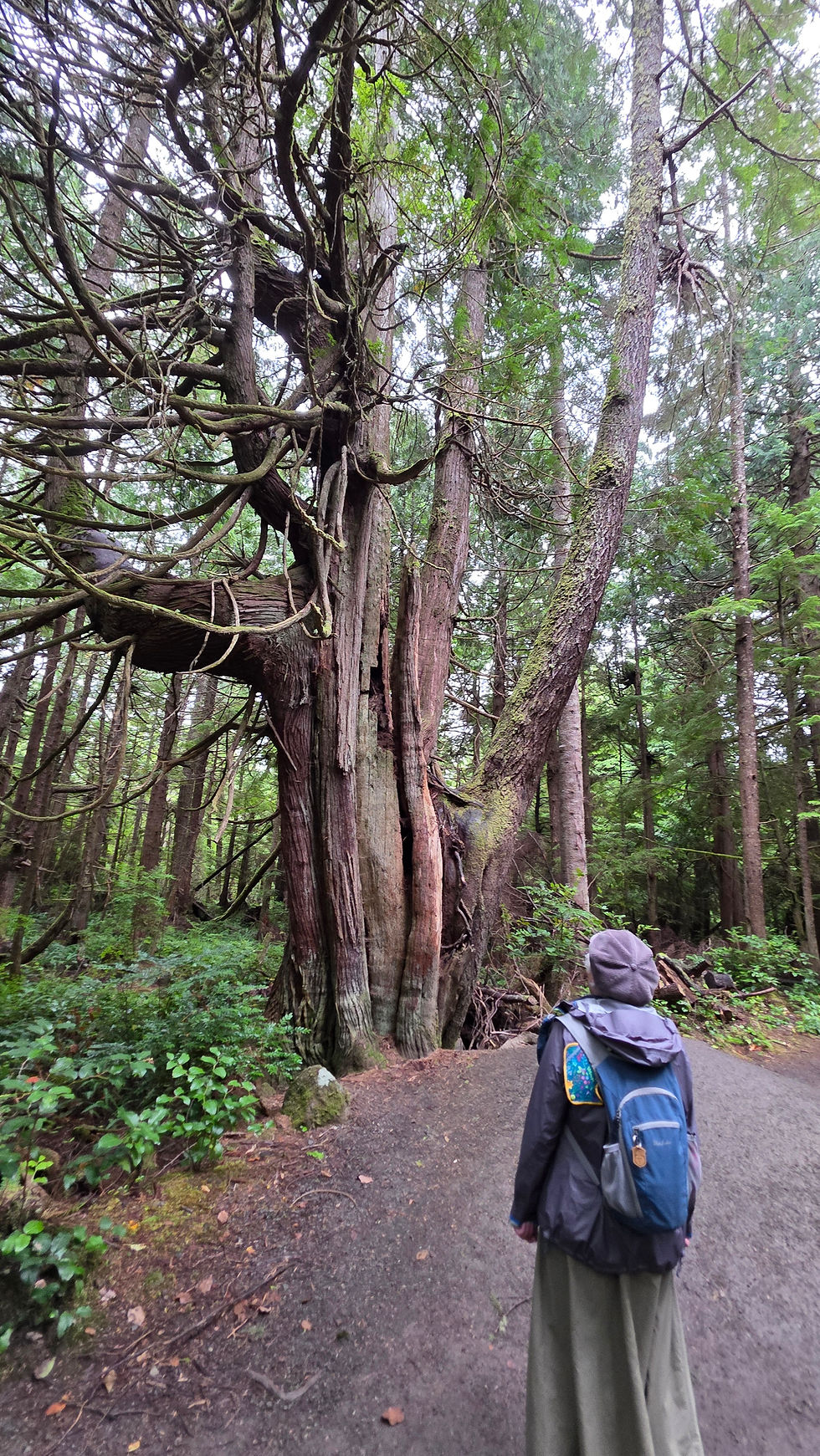
the most northwesterly point in the contiguous United States. Kath had never been here. The trail is wide and winding as it drops down through an ancient forest to the cape. We marveled at the cedars and spruce with their grotesque shapes, contorted by windstorms and falling trees through the years. The tread became a Dr. Seuss fairyland of planks weaving among the trees, high above ferns and skunk cabbage in places, twisting and turning with handrails that curve around corners, then becoming knobs of rocks to step on, then root mazes to solve carefully.
Sea lions croaked out “oarr, oarr, oarr...” in the distance. We were getting close.
We came to the edge of the continent at the top of cliffs, fingers of land jutting into the ocean, reaching out to Tatoosh Island offshore. Between the fingers were deep inlets leading into dark caverns, waves echoing inside, oystercatchers echoing outside, stunted trees standing guard above.

The muted evening light made it all glow with emerald greens and glinting golds, the sea shining silver, shimmering and alive. Stunning. Glorious.
We lingered as the magic wove a spell through us. “An eighth wonder of the world,” mused Kath, shocked by the immense beauty of it all.
Hiking back up the trail, we were mostly lost in silence, in our thoughts. The trail still offered whimsical strains of Seuss imagery; the trees still looked like he drew them on a dare. But we began to see the trees as living creatures, fellow creatures, individuals raised here, living their lives here, a shared life with every other creature, fellow soil partners, a village working together to live, grow, survive, and carry on regardless of what may come.
We got back to the campground, and we were no longer alone. A motorhome was parked five feet from us, with tents gathered around; on our other side, a family was busy putting up a mansion tent, just a few feet from our table. The rest of the campground was filling in too, generators humming, music playing, laughter and lighthearted conversations.
Rain drizzled. We slept soundly that night.
The next morning, we went the other direction, down to the Shi-Shi trailhead. It’s a two-mile hike through ancient forests with more Dr. Seuss whimsy in the boardwalks winding through a new forest, then through monster spruces twenty feet around. After a mile, the trail becomes a mud bed fifteen feet wide with side trails seeking new ways to avoid the mud. And this is in late August, the driest time of the year.

Shi-Shi is a world apart. Nothing but sand and surf, sea stacks and seagulls. Somehow we were blessed with sunshine the entire time, eating our lunch on a log in the shadow of sea cliffs, walking barefoot on pure beach sand, listening to the waves crashing ashore, then hissing in retreat, with the silent forest keeping watch. Backpackers trudged out of the south to take a break. We trudged back up the cliff to the trail of mud, the trail of giants, and now a trail of good memories to bring back home.
We drove straight to the Makah Museum in Neah Bay. Oh my. What an experience. Over fifty thousand artifacts from the Ozette dig are here, many on display in professional interpretive cases. We read through much of it, learning about the Makah culture, their lifestyles, skills, and ingenuity for living and thriving in this environment by working with what nature provided. For me, the highlight was walking into the full-scale replica of a longhouse, sensing what it took to live here, seeing fish drying in the rafters, fires inside to warm the place and smoke the fish, benches along the walls for sleeping, the entire building open, roomy, and spacious. Through the doorway, the sounds and smells of the ocean wafted in, a fog rising, with visions of canoes landing on the beach, families celebrating their return from catching seafood, then gathering together in the longhouse to eat, talk, sing, create clothing and tools, live with what they had, and share with all who lived in the village.

We found a book that illustrated this very life in detail, seeing a different way of life.
Then we were off to the town fair, a half mile of booths with fry bread, blankets, shirts, jewelry, drinks, drumming, singing, talking, neighbors rubbing shoulders and greeting those they know, their heritage on display for us all to enjoy. It was like a family gathering, a family of a thousand, mostly native peoples loving each other in a shared homeland.
Back at the campground, the number of campers had nearly doubled again. Our big-tent neighbors to the south asked if they could use our table to cook out of the rain, and of course we said yes. As they cooked, they shared their remarkable story of meeting in Peru, raising a family together, and now living near here.
On our other side, the motorhome neighbors, truly neighbors as they were Swinomish, spoke with us about people and places we knew in Skagit County, and about what it means to be here today on lands that hold their stories.

There were now hundreds of families camped around us, people of all politics, of all nationalities, of all beliefs and non-beliefs sharing food and laughter and the joy of strangers becoming friends, sharing the ordinary kindness of waiting in the toilet line together, cooking side by side, relating without walls, weaving into a celebration of life, a gathering that connects all peoples to the stories of this land and the trees and stones and animals that hold them — remembering how life once moved through this place centuries ago and feeling ourselves, for a moment, living it again, together, in this corner of the world.
We felt completely at home.
We are brothers and sisters after all. We are all in this together.
Further information:
In 1926, the Makah began celebrating Makah Days on the last full weekend of August. We didn’t know we had arrived here exactly 100 years later. It was meant to be.

I first came here for a high school marine biology class; we camped on the beach and studied tidepool life on the reef. I was last here fifty years ago, when my parents lived here for several years, becoming a part of the story of the people and land as my dad helped with the tribes’ fisheries research.
It felt good to be back.
Museum https://makahmuseum.com/
Makah https://makah.com/


Comments